In these rapidly changing times, a return to the body and its tempo, as well as the communication of an understanding of the relationships between body, space, and time are essential.
Contact_
Projects_
2023 – Present
Kohlenbunkerensemble, adaptive reuse, gernot schulz : architektur GmbH
05 2025
Performance, Theaternacht Bonn, with DanzaMAZ
05 2025
Choreographic Assistant, Neue Welt, Bundeskunsthalle Bonn, with Community Dance Bonn e.V.
10 2024
Workshop, Vom Körper zum Raum, Technical University Dortmund
06 2024
Choreographic Assistant, Schiff der Hoffnung, Bundeskunsthalle Bonn, with Community Dance Bonn e.V.
05 2024
Workshop, Connected in Motion: Körperliche Beziehungen durch Tanz erforschen, Bauhaus University Weimar
05 2024
Performance, Theaternacht Bonn, with DanzaMAZ
Experience_
2019 – Present
gernot schulz : architektur GmbH
2009 – Present
2020 – 2023
Bauhaus University, M.Sc. MediaArchitecture
2014 – 2019
Girzalsky + Göckemeyer
Architektur und Landschaftsarchitektur
2015 – 2018
University of Applied Sciences, Cologne, B.A. Architecture
Philosophy_
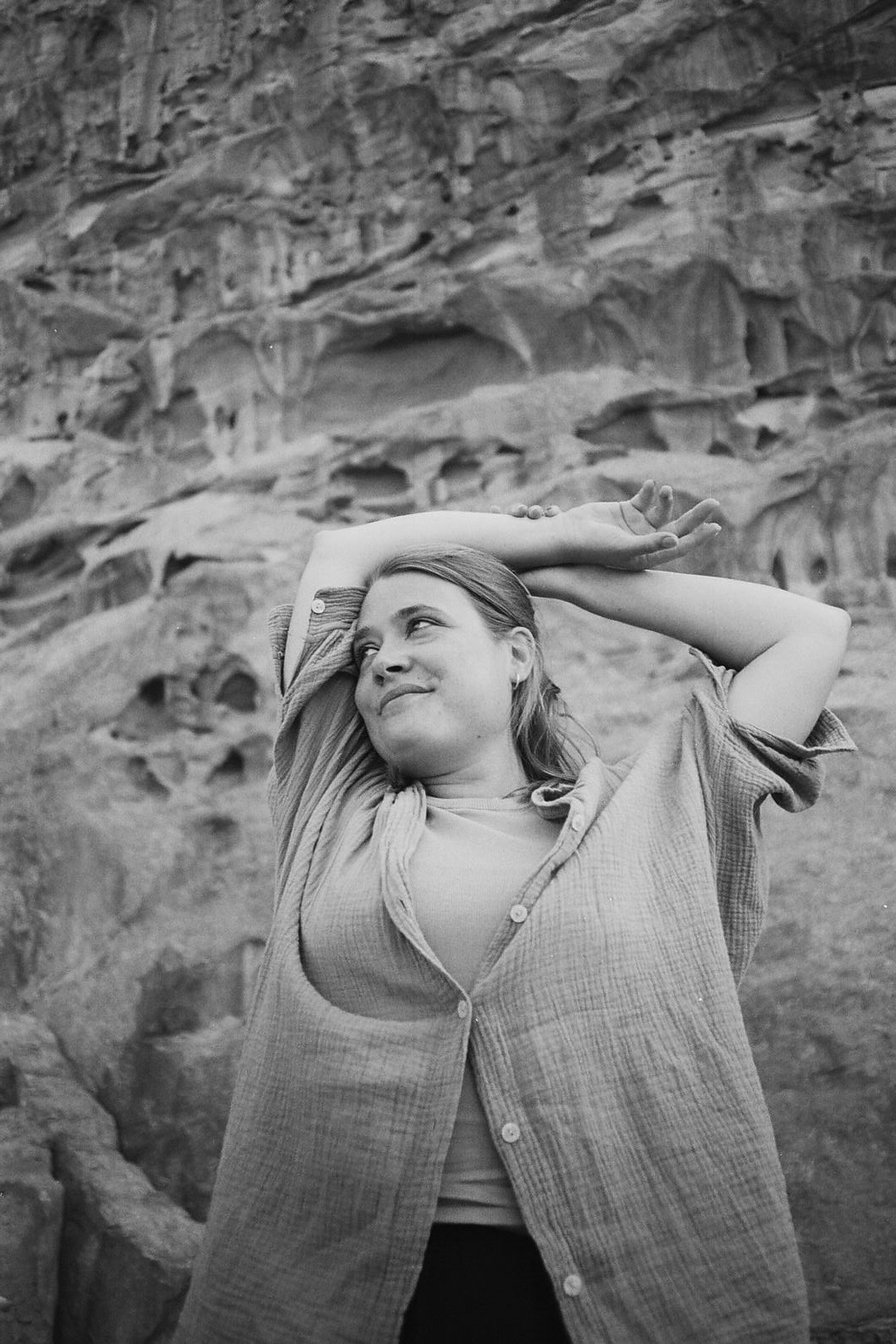
As an architect, choreographer, and researcher, I am working at the intersection of built space and lived experience. My work investigates how movement, sensory perception, and bodily presence can inform architectural thinking, and how spatial structures, in turn, shape our experience of the world.
In architecture, I work in project-leading roles, primarily in existing buildings. I am particularly drawn to working with old structures, materials and spaces that have developed their own life over time. These environments demand a heightened sensitivity: to what is already there, what has been, and what is yet to come. I believe that a building’s history deserves as much weight as its future. At the same time, architecture is grounded in economic and practical realities. This makes the navigation of transitional moments, such as those between preservation and transformation or between intention and constraint, a central part of the architectural process.
Dance offers a different kind of reality. It is a reality centered on the self: on presence, feeling, expression, and vulnerability. It invites us to perceive space from within, to listen to rhythm and resistance, to test the limits of our own body and its relationship to others. Where does my body begin and end? How do I relate to other bodies in space? What happens when boundaries dissolve? In dance, I explore spatial awareness not through plans or sections, but through physical intuition, timing, and shared movement.
It is this contrast between the outward orientation of architecture and the inward focus of dance that drives my interdisciplinary practice. I see choreography as a place where both disciplines come together. That is why I sometimes refer to myself as a space-maker, someone who creates, shapes, and questions space.
I am convinced that cultivating awareness of the body, its position in the world, its rhythms, its connections, can make us more sensitive designers. In times of increasing complexity and acceleration, I consider a return to the body and its rhythms not as a retreat from design, but as a method of deepening it. Understanding the relationships between body, space, and time is, I believe, essential for shaping spaces that are both responsible and responsive.
 Eva Girzalsky